
UN Assembly Opens Under Shadow of Wars, Economic Pressures and Questions Over American Influence
- International
- (Asia/Kolkata)
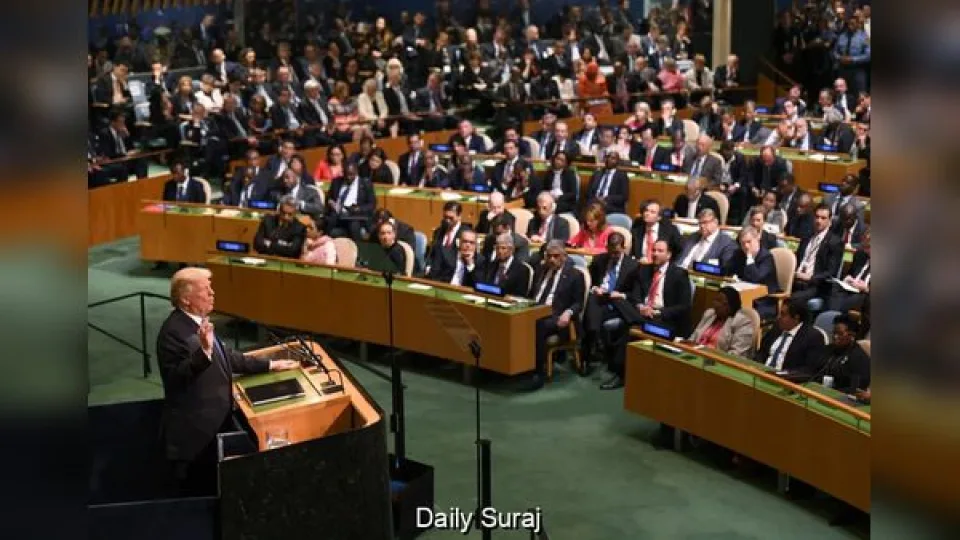
As world leaders assemble for the United Nations General Assembly, growing international conflicts, economic uncertainty, climate-related disasters and rapid technological change are fueling concerns about global stability. Against this backdrop, President Donald Trump is preparing to address the international community while facing increasing debate over the role of the United States in an increasingly volatile world.
The international environment has become more uncertain in recent months. Conflicts involving Iran and Ukraine continue to dominate global attention, while experts have raised concerns about the long-term risks associated with artificial intelligence. At the same time, rising energy costs have placed additional pressure on major economies already struggling with inequality and social tensions. Extreme weather events, including floods, wildfires and prolonged heatwaves, have also intensified concerns over the climate crisis.
The challenges have coincided with growing criticism of international institutions. The United Nations, which was established to encourage cooperation among nations, faces questions about its ability to respond effectively to conflicts and geopolitical tensions. Critics argue that global organizations are struggling to uphold principles such as democracy, human rights and international cooperation as powerful governments increasingly pursue their own national interests.
In previous decades, the United States was often viewed as a stabilizing force during periods of international uncertainty. However, analysts now argue that Washington itself has become a source of unpredictability under Trump's leadership. The president is expected to use his upcoming UN address to highlight what his administration describes as renewed American strength and influence.
Despite declining approval ratings ahead of important midterm elections and continued challenges abroad, Trump has repeatedly maintained that the United States commands greater respect on the global stage than ever before. Administration officials have indicated that the president will emphasize efforts to address international crises and promote peace.
That assessment, however, is not universally shared. Some traditional allies, particularly in Europe and Canada, have moved to strengthen cooperation among themselves amid concerns about the future direction of American foreign policy. Canadian Prime Minister Mark Carney recently suggested that countries should prepare for a changing international order and adapt to shifts in Washington's approach.
Trump's second-term foreign policy has been characterized by a willingness to use economic pressure, direct rhetoric and unconventional diplomatic strategies. Supporters argue these tactics demonstrate strength and prioritize American interests. Critics contend they have strained long-standing alliances and increased uncertainty among partners that once relied heavily on US leadership.
Questions about American influence have also emerged from ongoing international conflicts. Analysts point to the continued survival of Iran's leadership despite months of confrontation as evidence of the limits of military and economic pressure. Prolonged challenges in the region have also renewed debates about how effectively major powers can achieve their strategic goals in modern conflicts increasingly shaped by drone warfare and advanced technologies.
The president's foreign policy transformation has roots in themes he highlighted during his first UN General Assembly speech in 2017, when he emphasized an "America First" approach and encouraged other nations to prioritize their own interests. Since returning to office, Trump has intensified that agenda, frequently challenging allies while seeking engagement with leaders such as China's Xi Jinping and Russia's Vladimir Putin.
His administration has also pursued ambitious goals in the Western Hemisphere. Following political developments in Venezuela, the White House has promoted closer economic cooperation and energy-related agreements. Supporters view these moves as strategic successes, while critics argue they reflect a broader shift away from traditional US foreign policy principles.
The administration has faced additional challenges in its relationship with China. Trade disputes highlighted American dependence on critical materials, including rare earth minerals, which remain essential for advanced technology industries and AI-driven economic growth. These developments have underscored the interconnected nature of modern global competition.
Many foreign policy experts argue that previous American administrations would have sought broader international coalitions to respond to such challenges. Instead, Trump's tariff policies and sovereignty-related disputes have contributed to tensions within alliances that historically amplified US influence. European leaders, in particular, have expressed concern over Washington's support for certain populist political movements across the continent.
At the same time, some observers acknowledge that Trump's pressure on allies has encouraged increased defense spending, particularly in Europe. Supporters see this as a long-overdue adjustment that reduces dependence on American military resources.
Concerns about trust have nevertheless become a recurring theme among US partners. Greenlandic politician Tillie Martinussen recently compared changing perceptions of Washington to confidence lost after a trusted partner unexpectedly turns against its allies, reflecting broader unease in some international capitals.
Analysts note that many of the forces reshaping the global order predate Trump's presidency. Long-running wars, shifting economic power, China's rise, Russia's tensions with the West, climate challenges and advances in AI have all contributed to the current environment. Yet critics argue that Trump's confrontational leadership style has accelerated existing trends and deepened uncertainty surrounding the future of American leadership.
As Trump prepares to address the United Nations, the debate extends beyond his policies alone. It has become part of a broader discussion about whether the post-World War II international order is giving way to a new and less predictable era, and what role the United States will play in shaping it.



Leave a Reply