
SC Refuses to Halt MDR on UPI Transactions Above Rs 2,000, Issues Notices to Stakeholders
- National
- (Asia/Kolkata)
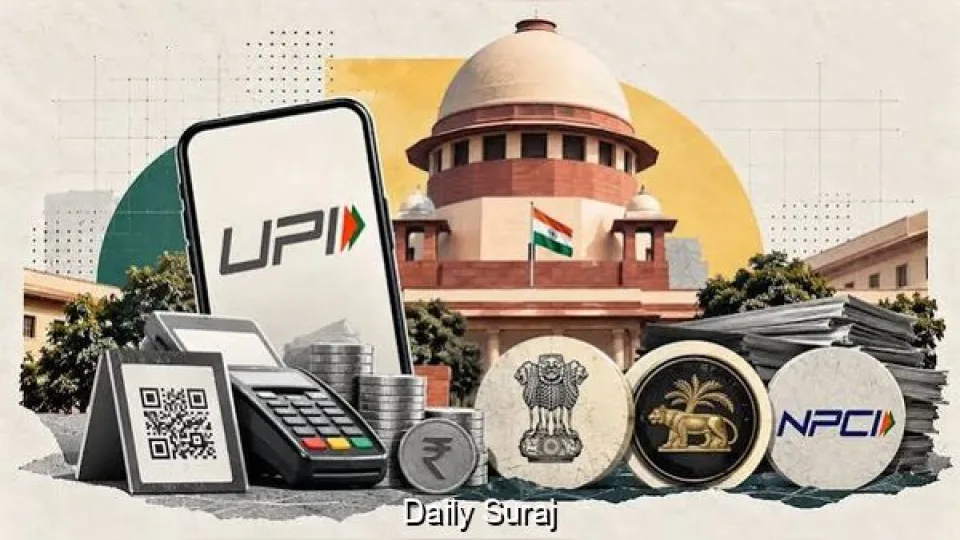
The Supreme Court on Monday declined to grant an interim stay on the Centre's decision to impose a Merchant Discount Rate (MDR) on specified Unified Payments Interface (UPI) person-to-merchant (P2M) transactions exceeding Rs 2,000. At the same time, the court issued notices to the Centre, the Reserve Bank of India (RBI) and other respondents on a public interest litigation (PIL) challenging the levy.
A Bench headed by Chief Justice of India Surya Kant observed that the matter appeared to be “less legal and more technical” in nature. The court directed the Centre, the RBI and other parties to file their responses within four weeks to the petition filed by advocate Anjan Datta.
During the hearing, Additional Solicitor General N. Venkataraman, appearing for the Centre, submitted that the MDR charges would become effective only from October 15. He informed the court that approximately 96 per cent of transactions would remain exempt from the levy.
The Centre also argued that the government would not receive any portion of the MDR collections. According to the submission, the charge is a settlement fee between banks and payment aggregators. When the Additional Solicitor General stated that the levy was “neither a tax nor a fee,” the Bench said the relevant facts should be placed before the court through an affidavit.
The petition challenges the Centre's September 14 notification issued by the Union Ministry of Finance and the MDR framework announced on September 15. The framework is scheduled to take effect from October 15.
Under the new structure, UPI payments of up to Rs 2,000 will continue to remain free of MDR. However, a 0.4 per cent MDR will be charged on general P2M UPI transactions above Rs 2,000. The levy is capped at Rs 300 for transactions worth Rs 75,000 or more. Certain essential sectors will attract a flat Rs 5 charge, while capital market-related payments will carry a 0.02 per cent levy. Merchants receiving up to Rs 1 lakh per month through UPI will remain exempt.
The government has maintained that nearly 96 per cent of merchant transactions will not be affected because they either fall below the Rs 2,000 threshold or qualify under the zero-MDR provisions available to small merchants receiving up to Rs 1 lakh per month through UPI QR code payments.
In his petition, Datta has contended that the MDR framework was introduced without adequate statutory safeguards, transparency or public consultation. He argued that despite official assurances that merchants would not pass on the cost to consumers, the levy could ultimately influence pricing structures, reduce working capital availability for businesses or encourage practices such as refusal of UPI payments and splitting of transactions among low-margin traders.
The petitioner clarified that he was not opposed to maintaining a secure digital payments infrastructure. However, he argued against imposing what he described as a nationwide payment burden without disclosing cost studies, methodology or enforceable safeguards to prevent the transfer of costs.
The PIL has named the Centre, the RBI, the National Payments Corporation of India (NPCI) and the UPI & Services Steering Committee as respondents.
Datta further argued that while UPI transactions above Rs 2,000 are being subjected to charges, RuPay-powered debit card transactions continue to enjoy no-charge protection without any monetary limit. The petition also questioned the rationale behind the Rs 2,000 transaction threshold and the Rs 1 lakh monthly receipt exemption, claiming these limits have not been supported by publicly disclosed data.
According to the petition, the difference in treatment between a transaction of Rs 2,000 and one of Rs 2,001 creates a financial threshold that could distort market behaviour. The plea also challenges the levy as arbitrary and alleges violations of Articles 14 and 19(1)(g) of the Constitution, while questioning the process through which the charges were introduced.




Leave a Reply