
Warmer, Drier Climate Expands Across Northwestern India, Raising Concerns for Agriculture
- National
- (Asia/Kolkata)
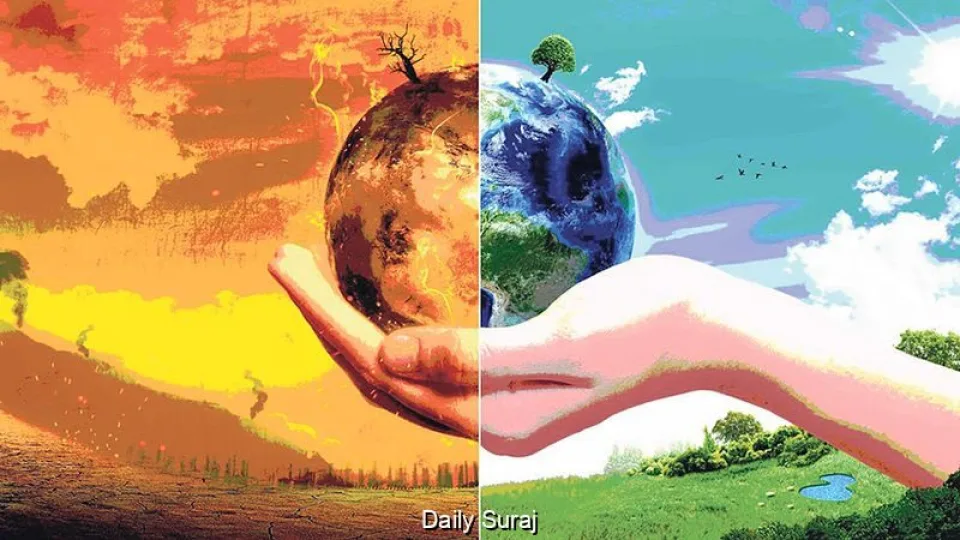
Northwestern India, including Punjab, has become warmer and drier over the past seven decades, according to a study by the India Meteorological Department (IMD) and the Indian Institute of Tropical Meteorology (IITM), Pune. The findings suggest that these climate changes could affect paddy cultivation and the timing of sowing and harvesting across the northern plains.
The study found that the region’s dry belt has expanded eastward, reaching western and eastern Uttar Pradesh, while much of southern India has become more humid.
Northwestern India, which includes Punjab, Haryana, Himachal Pradesh, Rajasthan, Uttarakhand, Uttar Pradesh and Delhi, has seen its hot semi-arid zone grow from roughly one-fourth of the region during 1951–1980 to about one-third during 1991–2020.
Rising temperatures and declining rainfall have caused an area equivalent to around 7 per cent of the region to shift into a drier climate category, the study found.
Climate shifts could affect crop schedules
Researchers warned that the changing climate could influence paddy farming in the northern plains, making close monitoring of sowing and harvesting schedules increasingly important.
To examine drying conditions across the northern plains, the researchers compared rainfall patterns in Uttar Pradesh, Bihar and western West Bengal with ocean temperatures between 1981 and 2020.
They found that years with lower rainfall corresponded with the Victoria Mode, a recurring pattern of warmer and cooler waters in the North Pacific Ocean. During one phase, this pattern can draw moisture away from northern India.
Ananya Karmakar, an IMD Pune scientist and lead author of the study, said a comparison of India’s climate maps from 1951 to 2020 showed the clearest changes in the north. The hot, dry zone had expanded eastward into Uttar Pradesh, she said, highlighting the need to closely track planting and harvesting periods in one of the country’s major agricultural regions.
Weak monsoon adds to concerns
The findings come after a weak monsoon that, according to the report, ended 12.6 per cent below normal, making it the weakest since 2015. El Niño, the periodic warming of the Pacific Ocean that can weaken India’s monsoon, was identified as a major factor.
Drought was also declared across large parts of Maharashtra, Karnataka, Telangana, Andhra Pradesh and Rajasthan.
IMD Director General Mrutyunjay Mohapatra, a co-author of the study, said the seven-decade record showed that India’s climate zones had changed within a single lifetime.
He said the monsoon’s 12.6 per cent shortfall this year was mainly linked to El Niño. Areas such as Marathwada and western Vidarbha, he added, now experience poor monsoons under drier climate conditions than those prevailing in the 1960s.
Mohapatra said the IMD would use the long-term climate findings alongside its seasonal forecasts and weather advisories for farmers.





Leave a Reply