
India’s First Highway-Urban Parking Pilot Project Launched in Ludhiana
- City
- (Asia/Kolkata)
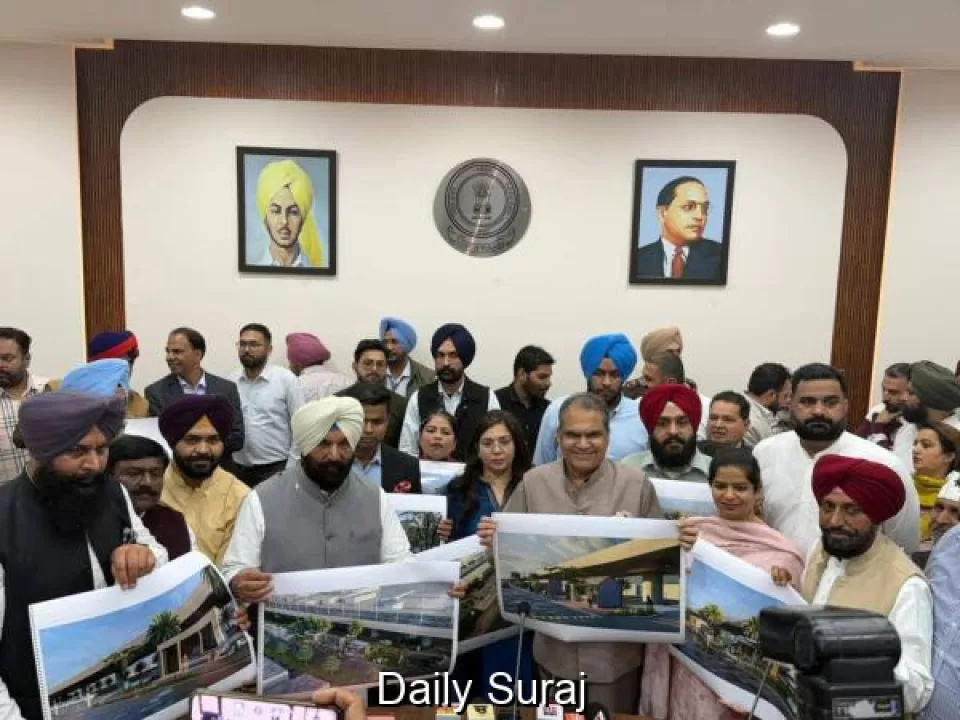
In a significant step towards modern urban infrastructure and scientific traffic management, Punjab’s Cabinet Minister for Industries and Commerce, Investment Promotion, Power, and Local Government, Sanjeev Arora, on Sunday formally inaugurated the construction of India’s first highway-urban parking pilot project in Ludhiana. The pioneering project is being implemented by National Highways Logistics Management Limited, a wholly owned subsidiary of the National Highways Authority of India. It represents a first-of-its-kind model aimed at optimizing the use of space along and beneath elevated highways in congested urban corridors. Several dignitaries and officials were present on the occasion, including MLAs Kulwant Singh Sidhu and Daljit Singh Grewal, Mayor Principal Inderjit Kaur, Municipal Corporation Commissioner Neeru Katyal Gupta, Deputy Commissioner Himanshu Jain, District Planning Board Chairman Jatinder Singh Khangoora, Ludhiana Improvement Trust Chairman Tarsem Singh Bhinder, MP Singh Jawaddi, and others. The project has materialized due to the sustained and dedicated efforts of Minister Sanjeev Arora, who has long advocated structured parking solutions to address Ludhiana’s persistent congestion and parking challenges. Continuous coordination with central agencies helped overcome key hurdles, accelerate approvals, and ensure the successful launch of the pilot project. Under the project, approximately 750 organized car parking slots will be developed by utilizing underused spaces along and beneath elevated highways. Key locations include the stretch from Bharat Nagar Chowk to Sidhwan Canal (between the main carriageway and service road) and from Bharat Nagar Chowk to ISBT under the elevated corridor. The project is expected to be completed within six months, with an estimated investment of ₹7 crore. The initiative will be executed under a Design, Build, Operate, and Transfer (DBOT) model with a concession period of 10 years. It also includes the development of 14 architecturally designed parking zones on both sides of the elevated road. These parking areas will be environmentally friendly, aesthetically integrated into the urban landscape, and equipped with modern facilities to ensure safe, organized, and efficient usage. Addressing the media, Minister Sanjeev Arora expressed satisfaction over the launch of the long-awaited project, emphasizing that it will significantly reduce the city’s ongoing parking shortage and traffic congestion. He stated that the initiative will provide safe, organized, and easily accessible parking facilities for daily commuters, shoppers, and residents, while also improving traffic discipline and road safety. He further noted that the project reflects a forward-looking approach to urban planning by scientifically utilizing vacant spaces beneath elevated roads. The model, he added, has the potential to be replicated in other cities across Punjab and the country. Reaffirming the government’s commitment to modern infrastructure, the minister said that under the leadership of Arvind Kejriwal and Chief Minister Bhagwant Mann, the Punjab government remains dedicated to people-centric development that enhances ease of living, supports economic activity, and promotes planned urban growth. He added that the state government will continue to collaborate closely with central agencies like the National Highways Authority of India and National Highways Logistics Management Limited to bring more innovative, sustainable, and globally benchmarked infrastructure projects to Ludhiana and other cities. The project is poised to emerge as a national model for organized urban parking and efficient utilization of highway-adjacent spaces, further strengthening Ludhiana’s position as a progressive and infrastructure-ready metropolitan hub.




Leave a Reply